The Line
$99 a year
For one voice: a trip, a year, a life.
One storyteller. Book download included, as many times as you like.
Every call adds to an archive: your own, one given to someone else, or one begun for a child with a parent’s consent. The voice, the words written out, and a book that grows with every call, ready to download again whenever you like.
Works on any phone, even a landline. No app to download.


A lifetime of memories
The same line, years later, is theirs to call.
The card
Every yearly plan and session comes with a 5×7 card, mailed in a plain envelope, plus a printable copy by email as soon as signup is done, so calling can start right away. The number and extension are on the front, so nobody has to look them up.

Who it’s for
For a child
Family fills the archive with their voices before the child can talk.
For yourself
A journal you keep by calling, from any phone, the moment something happens.
For a parent or grandparent
Their stories in their own voice, recorded anytime, written out and bound.
A Line can start at any age and stay with one person as they grow. Open one for a child and it starts as messages in your voice. When they are old enough to call, the same Line becomes their journal. The early recordings stay.
Until a child turns 18, a parent or guardian gives consent for them to record and looks after the archive: they can listen, delete any recording, or close the Line. At 18, we email the parent and hand the archive to the child. From then on it is theirs: they decide who listens and what stays, and they can keep adding to it for as long as they keep the Line.
Every Line also names a successor: someone you choose to receive the archive after you’re gone. When that time comes, they write to us, and a person here handles the handover.
For yourself or someone you love. Tell us who’s recording, and we mail a card with the number and extension.
Day or night, from any phone. Nobody answers. Just talk after the beep.
Every call is saved with its transcript. Family you add can listen and download while the plan runs and for 90 days after. What you download is yours to keep.

What you hear
or
The book
The book is included with every plan. You choose which stories go in, and you can download a new edition as often as you like, so next week’s, next month’s or next year’s can hold more than the one before. Every story has its own code in the margin: scan it and you hear the call itself, and the code on this page works.

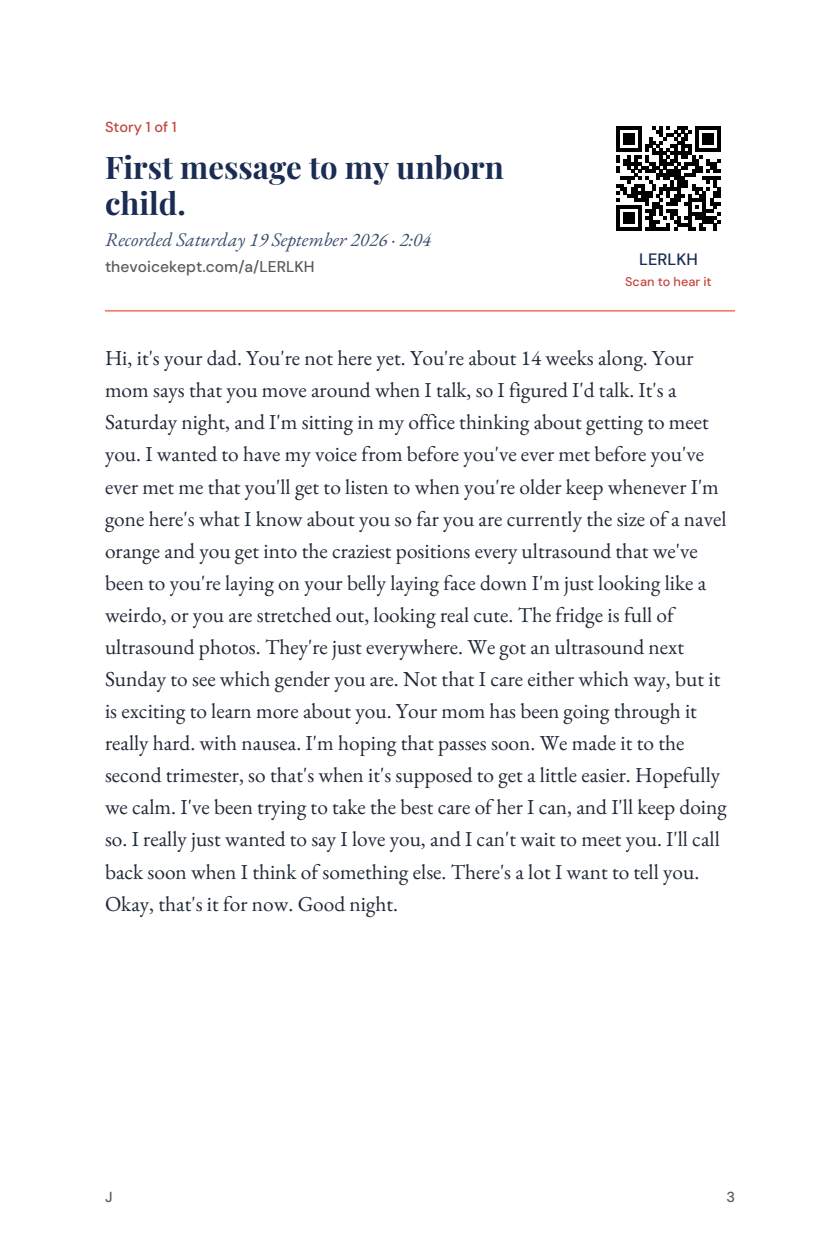
Print a real copy. Once there’s enough to bind, you get print-ready files and a short guide for ordering through Amazon KDP. No extra charge.
In the printed book, each story has its own code in the margin, linked to the recording of that story.
Pricing
$99 a year
For one voice: a trip, a year, a life.
One storyteller. Book download included, as many times as you like.
$149 a year
A parent and a child, or any two, each with their own extension.
Two storytellers, each with their own extension and archive. Book download included, as many times as you like.
$249 a year
The same, plus a drive of that year’s calls at year’s end.
Two Lines, plus a USB drive for each storyteller at the end of each year, holding that year’s recordings and transcripts. Book download included, as many times as you like.
Every yearly plan comes with a printed card for the fridge, mailed to you, with the number and the extension for that person’s archive. Every Line also includes our free guides, fill-in digital books to help you get the most from it, ready in your portal.
Every plan renews automatically. Cancel anytime. The year you’ve paid for keeps running to the end.
An interviewed session is a 75–90 minute recorded interview with a Vividly interviewer, and it includes a year of the Line (then $99 a year). $395.
Prefer to pay monthly? The Line is $19 a month and comes with a printable card by email. Cancel anytime.
Giving several? Write to hello@vividly.family and we’ll set them up together.
Fill-in booklets to help you get more from a Line, or simply learn something new about someone you love. Start with 24 thoughtful questions.
Enter your email and we’ll send your link to all of them, along with more free things like this from time to time.
Already have a Line? Sign in and you’ll find them in your portal.
What the Lines also do
5Lines
For every five Lines sold, someone in hospice care receives a Line free for 90 days. Anyone can refer them, and we confirm it with their hospice. The waitlist is private, and they consent on their first call, like everyone else.
10Lines
For every ten Lines sold, a veteran is interviewed, and the recording is prepared and submitted to the Veterans History Project at the Library of Congress.
You buy it for your own family. Someone else is heard because you did.


Questions
Yes. The Line is $99 a year, or $79 for the first year while the founding places last. Family Line covers two storytellers for $149 a year — each with their own extension and their own archive — and the Voice File adds a USB drive for each of them at the end of every year, for $249 a year. Monthly is $19. Every plan renews automatically, and you can cancel anytime. Whatever has been recorded stays downloadable in ordinary formats while the plan runs and for 90 days after it ends.
No, and that is deliberate. A greeting plays, then a tone, and the storyteller talks for as long as they like. Nobody is listening in, nobody is waiting, and there is no appointment to keep.
People generally say more to a recording than to someone sitting across from them. A pause to think is fine. If the line goes silent for about thirty seconds the recording ends, keeping everything they said, and they can call back and carry on.
A few minutes. You pay, enter the storyteller’s name and phone number on the next screen, and their number and extension are issued straight away. The card for the fridge is printable immediately.
After that there is nothing to set up. They call when they want to, and the archive fills at whatever pace suits them.
They’re a different product, and for some families the right one. Those send a prompt and wait for someone to sit down and write. Vividly is a phone line — the storyteller picks up any phone, a landline included, and talks, at whatever hour the thought arrives.
Writing something down captures the facts. It does not capture the voice saying them.
No. Vividly is audio only, on purpose. A phone call is the least intrusive way to have this conversation, and a camera changes how people talk — someone who is elderly, unwell, or telling you something difficult tends to say less with one in the room.
The voice is the part worth keeping.
Then it helps to know there is nobody to be uncomfortable in front of.
Nobody answers the Line. There is no interviewer, no appointment, and nothing to get right. They dial the number, enter their extension, hear a short greeting and a tone, and then talk. The recording does not interrupt and does not ask a follow-up. A pause to think is fine; about thirty seconds of silence ends the recording, and they can simply call back.
Most people who dislike the phone dislike being heard on it. There is nobody on the call at all — who can listen afterwards is a separate choice, and it is theirs.
The spoken prompts and the weekly questions are in English.
Nothing constrains what goes on the tape. A storyteller can record in whatever language they like, and it is kept exactly as spoken. The transcription attempts whatever it hears, but we have not tested it in languages other than English, so we are not going to tell you it works.
If you need another language, write and tell us which one. That is how we find out it is wanted. It is not a promise that we can provide it.
Nothing on the Line pushes. There is nobody asking a follow-up, so a subject that stays closed simply stays closed.
Any question can be skipped. On a call, they can press 3 to skip it for now, or 9 to skip it for good; a question that came by text can be skipped by replying SKIP. Skipped for good, it is not asked again. On the Line nothing is read out unless they press 1 to ask for a question. Anything they would rather nobody heard can be set to private in the portal. Family with access to the archive can also write questions of their own, and the Line says who asked.
Some of the best material arrives after a pause, and a pause to think is fine. About thirty seconds of silence ends the recording, keeping what was said, and they can call back whenever they are ready.
The storyteller, whoever paid for it. Once they have an email address the archive is in their name, and they choose who can listen, who can manage access, and who it passes to. Until then, the person who gave it holds it in trust for them. For a child under 18, their parent or guardian holds the archive until they turn 18.
Email hello@vividly.family with the storyteller’s name and the date of the recording, or the code or link printed beside it in the book. We’ll listen for your spoken consent on the recording. If it isn’t there, we’ll remove the recording, and its code stops playing, even in a book that’s already been downloaded.
Everything already recorded stays theirs — the audio, the transcripts and the archive, downloadable in ordinary formats.
When the paid time runs out the line stops taking calls. Listening, reading the transcripts and downloading carry on for 90 days after that, so there is time to download everything, and whatever has been downloaded is theirs to keep.
Yes. Buyer and storyteller are separate from the start: you get the receipt, they get the recordings and the archive.
If it is a surprise, a checkbox at signup holds back the email and text that would otherwise tell them about it, so you can hand it over yourself.
What cannot be held back is the consent. They agree to being recorded in their own voice on their first call, and nobody can do that for them. The one exception is a child under 18, where a parent or guardian agrees for them.
Yes, at any age. Until they turn 18, a parent or guardian has to agree before the Line will answer them.
Anyone can buy it. If that isn’t the parent, we email the parent, and the Line stays closed until they say yes.
Until the child turns 18, the parent looks after the archive: they can listen, delete any recording, or withdraw their consent, which closes the Line. At 18, we hand it to the child.
One number. A lifetime of memories. $99 a year.
Get the number